Home Overview Cost Resources Contact us
Tour Hi-lites Galleries Robin's Gallery Robin's Magazine Articles
Tour Overview
Travel in Cars

Our modern SUVs carry two traveling companions, an English-speaking guide and driver.  We leap-frog across the countryside and witness non-stop culture of all forms: dance, song, art, farming, archery (the national sport), wildlife, religion, weaving and textiles. Past participants have all been avid photographers who enjoyed rising at 5 a.m. to catch the fog lifting from a castle dzong, but also enjoyed participating in an archery match, catching a trout for dinner, riding a pony to a monastery, taking a hot stone bath, eating lunch at a Bhutanese farmhouse, hiking through a forest, and many other special events not listed on other Bhutan itineraries.

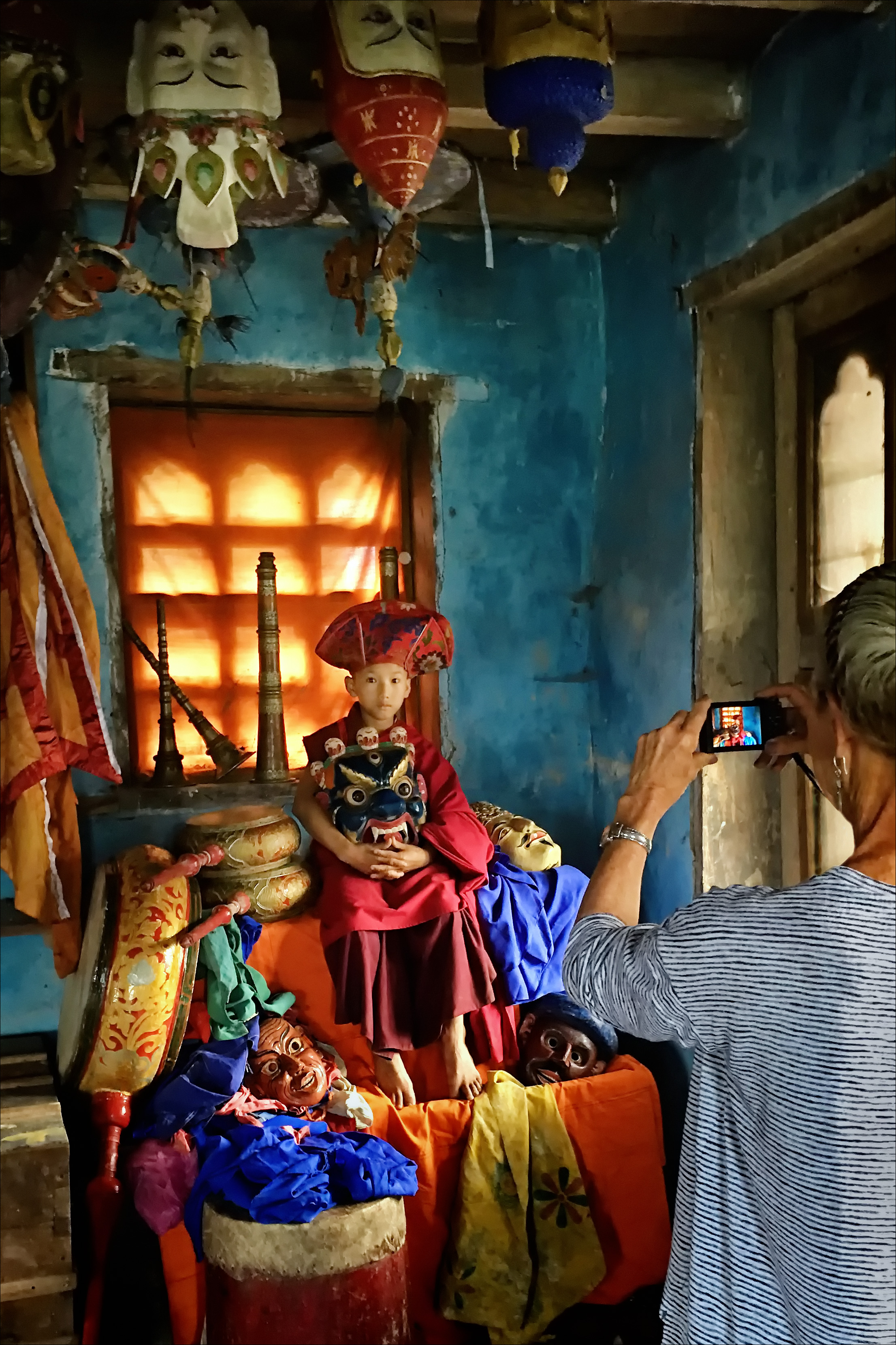
Both spring and fall tours go to a small temple in Phongmey in the far eastern side of Bhutan for an exclusive mini-festival put on by the nomads of Sakten and Merak. We also spend two nights in Ugen Choling, a small village an hour's hike from the road head through farm fields, where our guides and drivers (you too! if you want to) engage the villagers in an archery match. While there the National Dance Troupe will perform masked dances in the courtyard for our private mini-festival. We will also erect personal prayer flags, visit farmhouses, and have special access to the museum and temple where our tour is allowed to take photography.

Throughout the country we visit all of the sites that make Bhutan special: Tiger's Nest Monastery, National Traditional Art School, cheese/beer factory, handmade paper factory, national and monarchy museum, roadside markets, textile museum, main post office for collectible stamps, and the endangered Takin reserve to see the national animal to name just a few.

We welcome all levels of photographers--digital and film, pocket point-and-shoot, SLR, large format, etc.--and non photographers who want to become photographers or just want to join in on these incredible itineraries.

The main difference between this tour and others is our mode of transportation--cars, not a bus. As a photographer on tour, you may have found it difficult to take the time necessary to capture good images because you were holding up the bus and other tour participants while you worked a great scene.

On this tour, you will be in a car with one other photographer (or your traveling companion) a Bhutanese guideĀ and a driver who is ready to stop at a moment's notice. This way, you will have the freedom to ask the driver to stop as frequently as your photographic eye demands. You also have the freedom to break away for the day and go somewhere else—all things are possible when you travel in your own car.  Your personal guide and driver are eager to carry your gear, set up your tripod, and serve as a cultural guide and interpreter, answering your questions about his homeland.

Bhutan is not for travelers who expect five star accommodations and world-class cuisine, but rather for adventurers who are hardy and flexible. We will stay in first class Western-style hotels in Paro, Thimpu, and Wangdi, but as we move further eastward and stay in typical Bhutanese guest houses you should expect comfortable but “rougher” accommodations, as the Lonely Planet guide suggests. In the East, beds are thin foam mattresses on wooden platforms. Bathrooms are simple and showers are sometimes nothing more than a hose with a shower head protruding from the wall and a cement floor with a drain. At one 16th century monastery guest house on top of a mountain, a plastic pail of hot water is delivered to your room for a morning sponge bath.

Dinner and breakfast are Bhutanese food, always hot and served buffet style in hotels--lunch is usually boxed sandwiches and boiled eggs. Special diets are impossible to obtain. Vegetarians will enjoy abundant vegetables since ninety percent of Bhutan's 700,000 citizens are subsistence farmers. Fiery hot chili peppers are served as a vegetable entree and not mixed with other entrees. (In fact, many travelers find Bhutanese food to be quite bland.)  Fresh fruit is rarely served but frequently available at roadside markets.

It is said that the single mountainous road that traverses Bhutan turns every 9 seconds on average, and while it is paved, road repairs cause frequent slow-downs from the usual 30 mph. This road is also the main foot path and domestic animal trail--there are no bathrooms along the way, but plenty of bushes for your convenience.

Altitude sickness has not been a problem with any of the past participants. Altitudes range from 7,200 feet in Paro to 8,500 feet in Ura, with some passes at 12,000 feet. We move through the passes within a few hours and that's not high enough or time enough for altitude sickness to take hold. A few travelers complain of motion sickness but we have suggestions to keep that at a minimum.

Read On!

Tours are limited to 16 participants.
Non-photographers welcome too!

  • 2011 Group 2011 Spring Cross Country Cultural and Festivals Tour Participants and Guides (Photo by Peggy)
  • 2009 Group 2010 Fall Cross Country Cultural and Festivals Tour Participants and Guides (Photo by Joe Coveney)
  • 2009 Group 2010 Cross Country Spring Tour
    Participants and Guides
  • 2009 Group 2010 Spring Tour
    Participants and Guides
  • 2009 Group 2009 Cross Country Fall Tour
    Participants and Guides
  • 2009 Group 2009 Festival Tour Participants and Guides
  • 2009 Group 2009 Cross Country Spring Tour Participants and Guides
  • 2008 Group 2008 Tour Participants and Guides
  • 2007 Tour2007 Tour Participants and Guides
  • 2006 Tour Participants and Guides
  • 2005 Tour Participants and Guides
  • 2004 Tour Participants and Guides
rainbowgroup2002 Tour Participants and Guides
2003 Tour Participants and Guides
{column0}
{column0}